
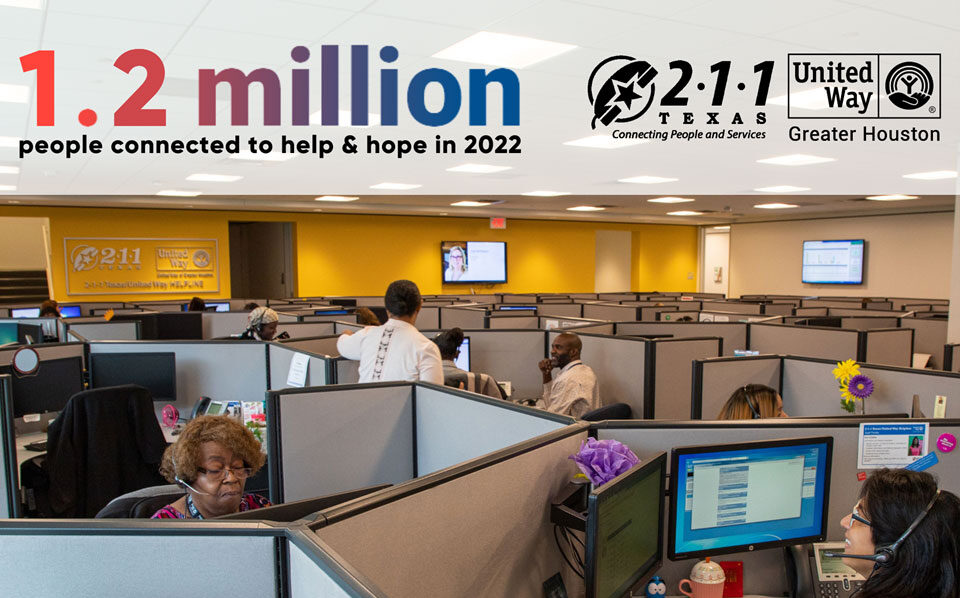
Houston, we need to talk about a number. No, it’s not the All-Star game score or the fluctuating price of a gallon of gas at the corner station. I’m talking about three digits that serve as the ultimate safety net for our community: 2-1-1.
This past week, I was invited to celebrate 211 Day—a moment to recognize the 211 Texas/United Way HELPLINE. If you follow my work, you know I’ve spent my career telling the stories of this city. I’ve seen our highest highs and our most devastating lows. And through it all, there is one constant, quiet force working 24 hours a day, 7 days a week, 365 days a year to make sure no Houstonian has to face a crisis alone.
Let’s look at the sheer scale of the impact right here in our backyard. In 2025, this helpline connected more than 1.3 million of our neighbors with the help they needed. Think about that. That’s not just a statistic; that’s 1.3 million moments of relief. That’s a mother finding rent assistance so her children don’t lose their home. That’s a veteran being connected to specific resources tailored to his service. That’s a senior citizen getting help with rising utility bills during a Texas heatwave or a sudden freeze.
The beauty of 211 is its simplicity in a world that is increasingly complex. When you don’t know who to call, you call 211. Don’t speak English? Not a problem, they provide service in over 350 languages. Whether it’s by phone, live chat, or texting your ZIP code to 898211, the United Way of Greater Houston has built a bridge between those in need and a comprehensive database of social services.
What many people don’t realize is that 211 is the “first responder” for life’s non-emergency crises. While 911 handles the immediate threats to life and limb, 211 handles the threats to stability. In 2025 alone, the data shows us the heavy lifting being done:
- Over 225,023 people connected with utility assistance.
- Over 177,557 people were helped with rent or mortgage payments.
- Over 100,000 neighbors guided toward food programs.
And it doesn’t stop at the basics. From finding quality child care to navigating the complexities of public benefits like SNAP and Medicaid, or seeking a haven from domestic violence, the trained specialists on the other end of the line are more than just operators—they are listeners. They blend expertise with a level of empathy that our city desperately needs.
As someone who has covered every major natural disaster to hit the Gulf Coast, I’ve seen 211 move into overdrive when the skies turn gray. They are the information hub before, during, and after the storm, providing up-to-the-minute info when everything else feels like chaos.
So, why does 211 Day matter? Because in a city as big and fast-paced as Houston, it is easy to feel invisible. 211 is the proof that you are seen. It’s the proof that our community cares enough to fund a system where help is always just three digits away.
To the specialists at the United Way of Greater Houston who took those 1.3 million calls last year: Thank you. You are the heartbeat of our resilience.
And to my fellow Houstonians: If you’re struggling to make ends meet or just don’t know where to turn, remember this number. It’s free, it’s confidential, and it’s there for you.
Don’t wait for a crisis to appreciate the safety net. Let’s celebrate the fact that in Houston, help isn’t just a possibility—it’s a phone call away.

For more information or to access the 211 database, visit unitedwayhouston.org or simply dial 2-1-1.
One thought on “Three Digits, One Heart: Why 211 is Houston’s Real First Responder”