“You cannot win without us, so you stay here, and you answer our questions—or you suffer the consequences.”
-Kandice Webber, a Houston nurse and political content creator,
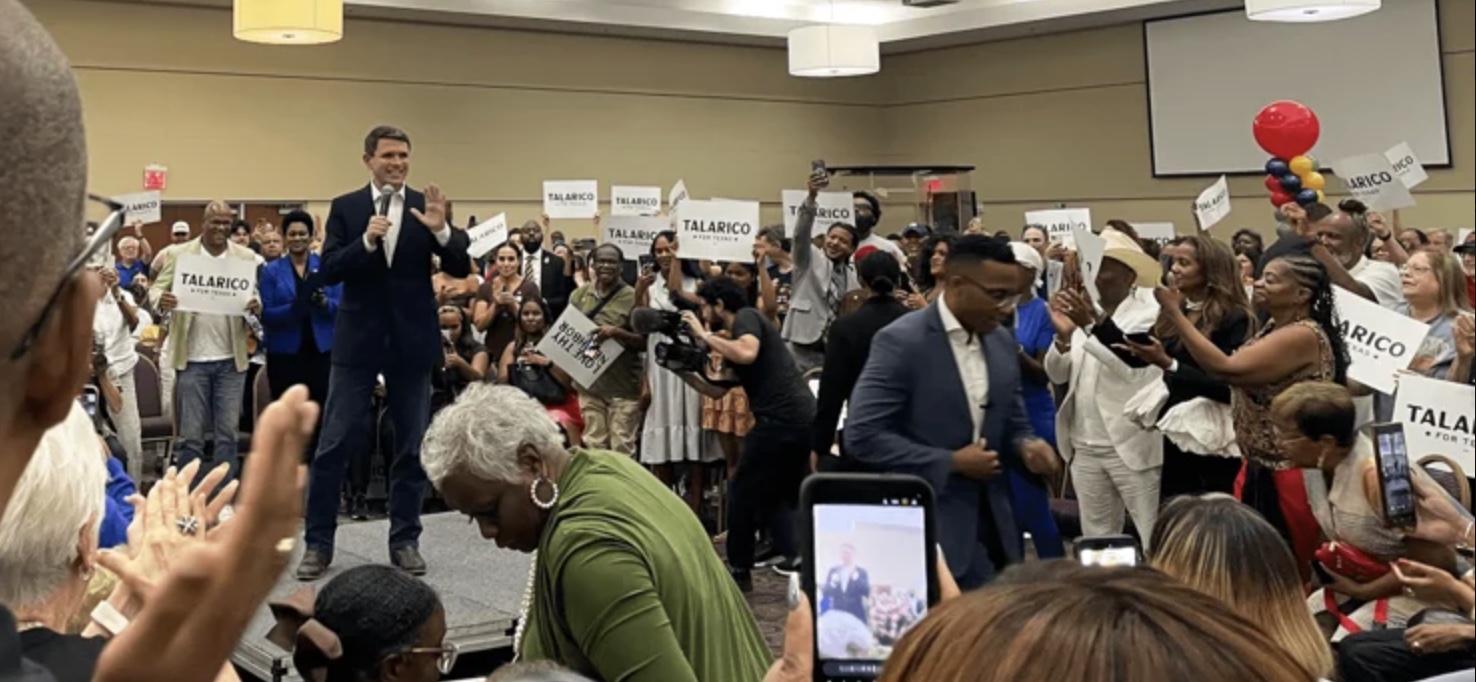
Earning the vote is vastly different from assuming you have it. Democratic U.S. Senate nominee James Talarico learned that firsthand on Sunday during a majority-Black town hall meeting at the Kingdom Builders Center in Houston. For more than an hour, the Austin Democrat faced intense questions and palpable frustration from Black voters who made one thing clear: their (88% to 90%) support must be earned, not taken for granted.
The event, introduced by U.S. Representative Christian Menefee (D-Houston), was organized to bridge gaps left by a bruising primary cycle. Talarico secured the nomination after defeating prominent Black elected official U.S. Representative Jasmine Crockett. Since then, he has faced online criticism and skepticism from community leaders claiming his campaign hasn’t done enough to engage Black Texans—a vital coalition for any Democrat hoping to win statewide.
“For far too long, the Democratic Party has taken Black folks for granted,” Menefee told the crowd. Talarico echoed the sentiment in his opening remarks, acknowledging that there is no path to victory against his Republican opponent, Attorney General Ken Paxton, without active investment in Black communities.
To show his commitment, Talarico announced a historic $25 million pledge dedicated entirely to Black voter outreach—a sum he noted is the largest investment of its kind in modern Texas history.
Attendees pressed the state lawmaker on critical issues, including voting rights, Black rural farmers, immigration, and ongoing conservative attacks on diversity, equity, and inclusion (DEI) initiatives. Questions were raised regarding the racial diversity of his own campaign staff and how his team plans to lift up down-ballot Black candidates.
But that wasn’t the only grievance addressed. Talarico specifically called out prominent online supporters—including national strategists like Keith Edwards and accounts like Rogue DNC—who had been attacking Black political commentators and Congresswoman Jasmine Crockett online, demanding they stop the infighting because the campaign has work to do.
“I don’t want any Texan to vote for me just because they don’t like Ken Paxton. I want people to be excited about what we’re trying to do.”
— James Talarico, Democratic U.S. Senate Nominee

While local precinct chair Earnest Babalola Goodrich told Talarico he had “sold him” despite initially backing Crockett, others remained deeply skeptical. The tension erupted near the end of the town hall when staff attempted to cut off the microphone after 45 minutes of audience questions.
Kandice Webber, a Houston nurse and political content creator, interjected from the crowd, demanding Talarico stay to answer every remaining question. “Black people don’t trust you for this reason,” Webber shouted to a mix of applause and murmurs. “You cannot win without us, so you stay here, and you answer our questions—or you suffer the consequences.”
Talarico extended the Q&A session by twenty minutes, promising to address outstanding questions individually in the photo line. However, the friction only intensified online. Following the town hall, Webber doubled down on social media, labeling Talarico a “Teach for America plant” pushing for school privatization. It is a charge that Talarico’s legislative record heavily complicates, given his high-profile leadership in blocking Governor Greg Abbott’s private school voucher expansions.
Yet, the core issue for many attendees extended far beyond charter schools—it centered on how the campaign manages its messaging, and more importantly, who it trusts to deliver it.
Historically, legacy mainstream media has consistently sidelined communities of color or failed to protect them from targeted disinformation campaigns. We saw this play out starkly in Virginia’s recent election cycles, where weaponized text message campaigns and deceptive ads were intentionally funneled into Black communities to suppress and confuse the electorate. For Black voters, who controls the narrative is a matter of political safety.
This systemic failure underscores a deeper, structural critique raised by local media leaders. In an op-ed titled “When Words and Actions Don’t Align: Reflections on Black Media, Campaign Outreach, and Respect,” Lisa Valadez, Associate Publisher of Houston Style Magazine, challenged the authenticity of the campaign’s approach.
Valadez revealed that since the launch of Talarico’s run, the historic Black press publication had proactively provided his staff with contacts for trusted, independent Black and Hispanic-owned media outlets and local PR firms. The goal was simple: help the campaign build genuine infrastructure in hard-to-reach communities. Instead, those resources were met with monthslong delays, culminating in a staffer reaching back out for the exact same information months later.
While Talarico declared on stage that he cannot win Texas without Black media, Valadez’s account exposes a frustrating disconnect between the candidate’s rhetoric and his staff’s execution. It raises critical questions that echo far beyond this single race: Is the candidate aware of how his campaign is engaging with Black media? Does the campaign’s outreach reflect the values he expressed publicly? Are trusted Black media organizations viewed as genuine partners in community engagement, or only as an audience to acknowledge from the stage?ow his staff is engaging—or failing to engage—with the Black press?
This dynamic is a textbook example of a systemic pathology within the Democratic Party. Year after election year, the Democratic establishment pours hundreds of millions of dollars into high-priced, mainstream corporate ad agencies while routinely starving or ghosting the local Black-owned press—the very institutions that have spent decades earning the trust of the party’s most loyal voting base. Independent Black media outlets are frequently treated as an afterthought, called upon only for last-minute “Get Out the Vote” drives rather than being embraced as genuine strategic partners.
For independent newsrooms and voters alike, the takeaway is clear: if Talarico’s historic $25 million pledge is funneled into the same old corporate media channels rather than the Black institutions doing the groundwork, it will result in expensive noise rather than real relationships.
Recent polling shows Talarico holding 80% of likely Black voters compared to Paxton. While a high number, it trails the historical 90% benchmarks achieved by past nominees like Beto O’Rourke and Colin Allred. For Texas Democrats, the primary threat isn’t voters defecting to the GOP; it’s the danger of voters staying home.