The White House Correspondents’ Dinner is traditionally a night of “constructed tension”—a high-glitz ballroom where the people who run the country and the people who cover them pretend, for three hours, that the stakes are only as high as the next punchline.
But on Saturday night at the Washington Hilton, at approximately 8:36 p.m., the sound of 2,600 people clinking wine glasses was replaced by the staccato of gunfire and the terrifying command to “Get down!” What followed—the sight of Secret Service agents swarming the head table to whisk away the President and Vice President—is now etched into the history of the most volatile year in modern American politics.

The Facts
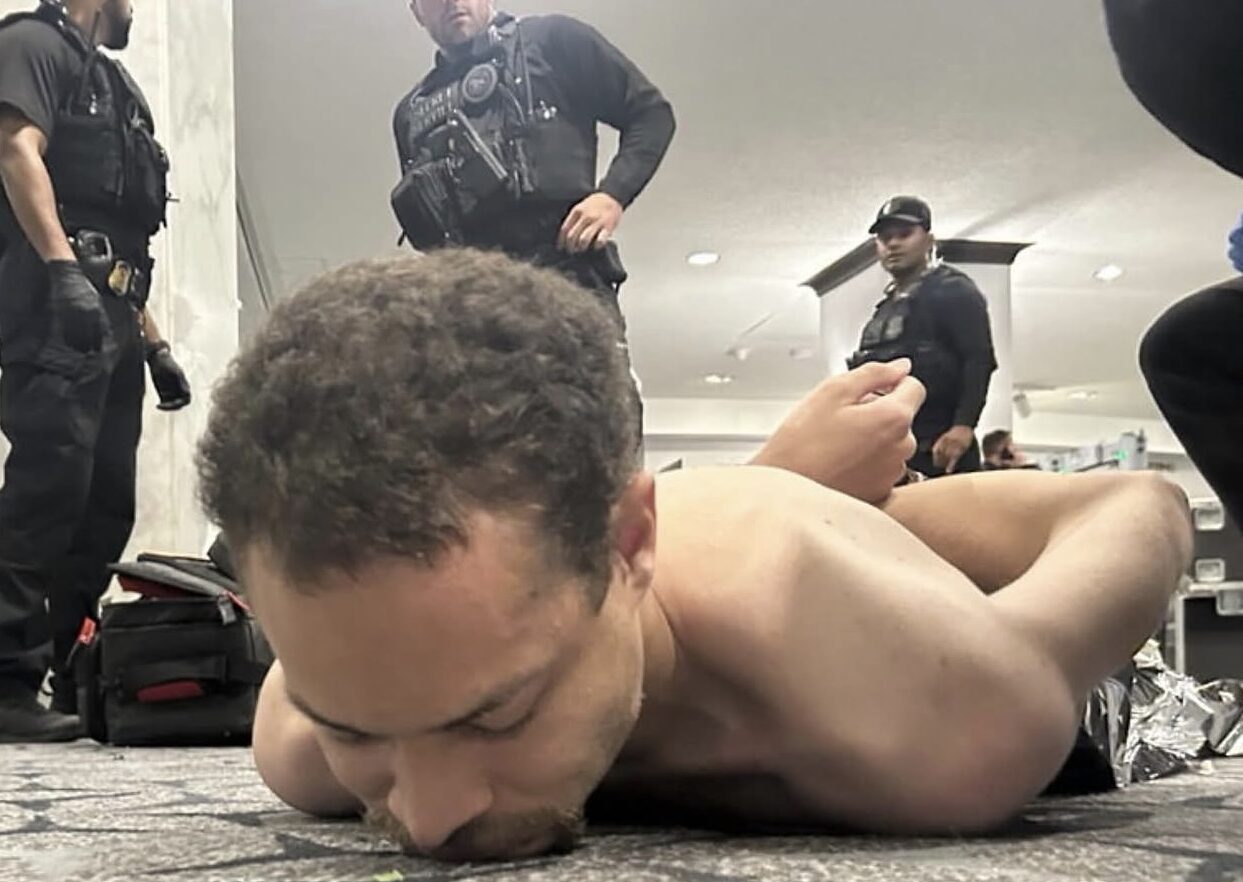
Law enforcement has identified the suspect as Cole Tomas Allen, a 31-year-old educator and video game developer from Torrance, California. Allen, a registered guest at the Hilton, reportedly bypassed a secondary security checkpoint near the ballroom magnetometers. He wasn’t just “armed”; he was a walking arsenal, carrying a shotgun, a handgun, and multiple knives. One Secret Service agent was struck in the chest but was saved by their bulletproof vest. Journalists like Wolf Blitzer, who was only a few feet away, and April Ryan, who was inside the room, have provided harrowing firsthand accounts of the chaos.
The Skeptics
“For a President, who has now had 2 attempts on his life, scrubbing the entire area should have been a requirement, or does this administration not take the 47th President’s life seriously?” – American Citizens
- ”Security Loophole” – While the “staged” theories aren’t easily dismissed nor easily proven, a more credible and uncomfortable skepticism has emerged regarding the security perimeter itself. Critics are rightly asking: How does a man with that much arsenal and ammunition move through a hotel hosting the President of the United States? The skepticism here is grounded in a systemic flaw. While the ballroom was a fortress, the hotel itself remained a public space. Allen’s status as a registered guest gave him a “cloak of invisibility” that allowed him to move weapons from his room toward the final screening line. That would mean rooms around the ballroom weren’t cleared by the Secret Service. The question remains HOW and WHY NOT?
- The “Unsecured Building” – Standing before the press still in his tuxedo, Trump described the Washington Hilton as “not a particularly secure building.” He contrasted the public nature of a commercial hotel with his planned “Militarily Top Secret Ballroom,” which is currently mired in legal and budgetary battles.
- The Pitch: Trump argued that the shooting—which involved a suspect who was a registered guest at the hotel—is the ultimate proof that the presidency needs a secure, “drone-proof,” and “bulletproof” event space within the White House gates.
- The Truth Social Follow-up: By Sunday morning, he doubled down, stating the shooting “would never have happened” if the ballroom were already completed.
Why Skeptics Call it “Convenient”

For months, the ballroom project has been stalled by a federal judge who ruled that construction cannot proceed without explicit congressional approval. However, a specific legal loophole exists: the administration can take “actions strictly necessary to ensure the safety and security of the White House.”
Skeptics in the newsroom and on the Hill have noted that:
- A “Made-to-Order” Crisis: The shooting provides the exact “security necessity” argument needed to bypass the court’s restriction. By framing the Hilton as inherently dangerous, the administration creates a legal pathway to resume construction without a vote from Congress.
- The Rescheduling Twist: While the White House Correspondents’ Association (WHCA) has stated they will reschedule the dinner, Trump’s allies—including Rep. Randy Fine and Louisiana Gov. Jeff Landry—are already suggesting that future dinners should only be held in the “safe, impenetrable” White House ballroom.
Necessity or Opportunism?
As a person in media, the optics here are striking. On one hand, you have Senator John Fetterman and other attendees acknowledging that the Hilton was not designed to protect the entire line of succession. On the other hand, you have a President who is a master of “branding a crisis.”
| Perspective | The Argument |
| The Administration | The Hilton is a “security nightmare” where guests can smuggle shotguns to the lobby. The White House ballroom is a mechanical necessity for safety. |
| The Skeptics | This is a “Shock Doctrine” move. The President is using a traumatic security breach to push through a $400 million vanity project that was legally dead 48 hours ago. |
Is the ballroom a legitimate shield for the First Amendment, or is the shooting being used as the “green light” to build a fortress that excludes the public and the press from the very traditions they are meant to celebrate? When the President says he’s “studied assassinations” and then asks for a $400 million room, the subtext isn’t just about security—it’s about control. Especially since this is his first time attending as a sitting President and skeptics are saying he won’t be at the rescheduled dinner.
In the aftermath, the President has leaned into the “lone wolf” narrative. But as multiple media voices have pointed out, labeling every attacker a “lone wolf” can be a convenient way to ignore a broader, more dangerous climate. We are living in a year where political volatility has surged.
Saturday night was supposed to be a celebration of the First Amendment. Instead, it became a somber reminder that in 2026, this presidency is becoming the most “violent” in modern-day history.
In the immediate aftermath of the shooting, President Trump’s address from the White House shifted quickly from the chaos of the ballroom to a high-stakes legislative pivot. For many observers—especially skeptics—the speed with which he linked the trauma of the evening to his controversial $400 million White House ballroom project felt remarkably “convenient.”
Update for Monday:
On Monday, April 27, 2026, the investigation into the White House Correspondents’ Dinner (WHCD) shooting has moved rapidly into the federal court system. Here is the latest as of Monday morning:
1. Federal Arraignment and Charges
Cole Tomas Allen is scheduled to appear in federal court in Washington, D.C., later today. U.S. Attorney Jeanine Pirro announced that Allen currently faces preliminary federal charges, including:
- Two counts of using a firearm during a crime of violence.
- Assault on a federal officer using a dangerous weapon.
Authorities have indicated that additional charges are likely as the FBI continues to process evidence from his hotel room and electronic devices.
2. The “Friendly Federal Assassin” Manifesto
New details have emerged regarding a manifesto Allen sent to his family members just 10 minutes before the shooting began.
- Target List: In the document, Allen reportedly referred to himself as a “Friendly Federal Assassin” and included a prioritized list of targets, with senior Trump administration officials at the top.
- Family Warning: Allen’s brother, located in Connecticut, reportedly notified local police as soon as he received the document. Simultaneously, the Secret Service interviewed Allen’s sister in Maryland, who noted that her brother had a history of making radical statements about “fixing the world’s issues.”
- The Message: In the writing, Allen allegedly mocked the “insane” lack of security at the Hilton and stated, “if I could have seen any other way to get this close, I would have taken it.”
3. Suspect Background: “Borderline Genius”
Journalists from Pasadena Now and NBC News have dug into Allen’s professional and academic history, revealing a high-achieving but increasingly radicalized individual:
- Education: Allen is a 2017 graduate of Caltech (Mechanical Engineering) and earned a Master’s in Computer Science from Cal State Dominguez Hills in 2025.
- Employment: He was a part-time teacher at C2 Education (even winning a “Teacher of the Month” award in late 2024) and an independent game developer.
- Political Activity: Federal Election Commission (FEC) records show a $25 donation to ActBlue in October 2024. Investigators are also looking into his ties to a group called “The Wide Awakes” and his participation in “No Kings” protests in California.
4. Security Loophole Confirmed
Interim D.C. Police Chief Jeffery Carroll confirmed Monday that Allen was indeed a registered guest at the Washington Hilton. This status allowed him to bypass the heavy outer perimeter security, as he was already “inside” the hotel’s ecosystem before moving toward the ballroom’s magnetometer line with a shotgun, a handgun, and knives.
5. The Ballroom Project Pivot

On the policy front, the shooting has immediately impacted a major White House legal battle. Acting Attorney General Todd Blanche sent a letter to the National Trust for Historic Preservation on Monday, citing the shooting as “incontrovertible evidence” that the President is not safe in public hotels. The DOJ is now using the incident to pressure the court to lift the injunction on the $400 million White House ballroom project, claiming it is now a matter of “strictly necessary” national security.
Monday’s developments show a clear two-pronged narrative: law enforcement is focusing on the “targeted” nature of Allen’s manifesto, while the White House is using the “loophole” of his hotel stay to fast-track their own infrastructure goals. For our newsroom, the key follow-up is the Secret Service’s internal review—specifically, how a guest was able to move three major weapons from a hotel room to a presidential screening area without detection.
As we look toward rescheduling this dinner, the conversation cannot be just about metal detectors and guest lists. We have to ask ourselves how we reached a point where a ballroom full of journalists and public servants is a target. The Secret Service vest saved a life on Saturday, but it can’t save the soul of our national conversation. That part is on us.
For those looking to support the community, the Washington Association of Black Journalists and other press organizations continue to advocate for the safety of the media. Stay tuned for updates on the rescheduled event.